


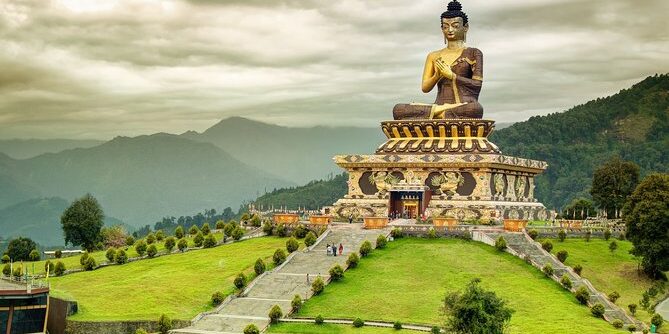


In a world increasingly shaped by geopolitical volatility, trade rivalries, and ideological competition, India possesses a civilizational asset no other Asian power can claim: it is the birthplace of Buddhism. At a time when China is actively shaping narratives, infrastructure, and influence across Asia, India’s most strategic long-term response does not lie in mimicry of hard power. Instead, India can consolidate soft power rooted in Buddhist philosophy, institutions, and transnational networks, projecting influence through ethics, culture, and dialogue.
The most practical manifestation of this vision would be the creation of a Buddhist diplomatic network across Asia—a flexible, non-confrontational group of Buddhist and Buddhist-influenced nations, anchored culturally, intellectually, and diplomatically in India. India’s role would not be that of a “Vishwaguru” or dominating power, but that of a humble, mature host, a convenor providing space, guidance, and moral leadership while treating all participating nations as equals.
Buddhist philosophy itself provides a guiding framework for such a network. The Dhammapada teaches: “All beings tremble at violence; all fear death. Putting oneself in the place of another, one should not kill nor cause another to kill.”
This principle underlines humility, empathy, and equality, essential for a diplomatic initiative where India hosts but does not dominate. Tsongkhapa’s Lamrim Chenmo emphasizes that true influence arises from compassion, wisdom, and ethical conduct, not force, while Shantideva in the Bodhisattva’s Way of Life instructs: “May I be a guard for those who need protection, a guide for those on the path, a boat, a bridge, a passage for all beings.”
Applied to diplomacy, these teachings suggest that India’s leadership should be service-oriented, facilitating collaboration and protecting cultural and spiritual heritage, rather than asserting supremacy.
India’s immediate neighbors would find significant benefit from joining such a network. Nepal, the Buddha’s birthplace, shares millennia-old religious, cultural, and trade connections with India. Collaboration would strengthen Nepal’s civilizational identity, protect Buddhist heritage sites, and enhance joint educational and cultural projects. Bhutan, a Himalayan kingdom with Vajrayana Buddhist traditions, would gain a platform for international engagement that aligns with its philosophy of Gross National Happiness, while fostering monastic and academic exchanges. Sri Lanka, as a Theravada Buddhist heartland, would benefit from shared monastic education, pilgrimage tourism, and research collaboration, deepening both its spiritual and cultural influence. For these nations, a network anchored in India offers mutual reinforcement of heritage, ethical governance, and dialogue, without the imposition of dominance by any single power.
Southeast Asian nations, including Thailand, Myanmar, Cambodia, and Laos, would similarly find value in such a network. Thailand’s royal and monastic institutions could strengthen cross-border scholarly exchanges, meditation programs, and initiatives promoting ethical leadership. Myanmar, Cambodia, and Laos, while navigating internal political complexities, would benefit from a platform to preserve Theravada traditions and promote regional cohesion based on shared Buddhist principles. East Asian countries, such as Japan and South Korea, home to Zen and Seon traditions, and Taiwan, with active Buddhist civil society, would gain access to India’s rich historical scholarship, monastic networks, and platforms for ethical diplomacy. Mongolia and Russia’s Buddhist regions—including Buryatia, Kalmykia, and Tuva—bring Vajrayana traditions closely connected to Tibet, making India a natural hub for scholarly, cultural, and religious engagement.
The network would be further strengthened by India’s role as the host of Tibetan Buddhism, particularly through the institutions and teachings of His Holiness the 14th Dalai Lama. Tibetan Buddhism represents a living continuation of India’s classical Buddhist traditions, blending philosophy, ethics, and pedagogy in a complete system. With global attention likely to focus on the next reincarnation of the Dalai Lama in India, the country is uniquely positioned to become the spiritual and educational hub for Tibetan Buddhist activity in Asia. Monasteries, academic institutions, and scholars provide a reservoir of ethical, philosophical, and cultural knowledge that can guide collaborative initiatives across nations. As the Dalai Lama has emphasized: “India is the only country that can combine modern education with ancient Indian wisdom. This is India’s greatest potential contribution to the world.”
Ancient Buddhist texts reinforce the value of such cooperative engagement. The Mahaparinibbana Sutta instructs: “Meeting together in harmony, rising in harmony, and conducting their affairs in harmony.”
The Bodhisattva’s Way of Life similarly emphasizes acting for the benefit of all beings through patience, compassion, and ethical conduct. Applied to contemporary diplomacy, these teachings suggest a network where influence is exercised through shared learning, ethical guidance, and cultural exchange rather than coercion.
Strategically, this network offers India a subtle but effective way to counterbalance China. By consolidating Buddhist and Buddhist-influenced nations around shared ethical, cultural, and educational goals, India can create a strong Asian diplomatic circuit that shapes thought and norms without direct confrontation. Unlike military alliances, this network relies on shared values, moral authority, and civilizational credibility, creating a durable counterweight. India’s leadership, in this context, would be moral, intellectual, and facilitative, strengthened by centuries of heritage and by the legitimacy of being the birthplace of Buddhism.
India’s Buddhist heritage offers both a civilizational treasure and a strategic opportunity. By convening a network of Buddhist and Buddhist-influenced nations, India can strengthen cultural bonds, provide platforms for shared learning, support the preservation of spiritual heritage, and project influence ethically. By acting as a humble, mature host, India ensures that all nations have an equal voice, fostering trust, collaboration, and solidarity. As the Dhammapadareminds us: “Better than a thousand hollow words is one word that brings peace.”
For India, Buddhism can be that word—a guiding principle for building a resilient, ethical, and collaborative Asian diplomatic network capable of navigating the challenges of the 21st century while promoting harmony, shared heritage, and mutual respect. By combining spiritual wisdom with strategic foresight, India can create a network that preserves traditions, strengthens regional ties, and establishes ethical influence as a defining feature of Asian diplomacy.