


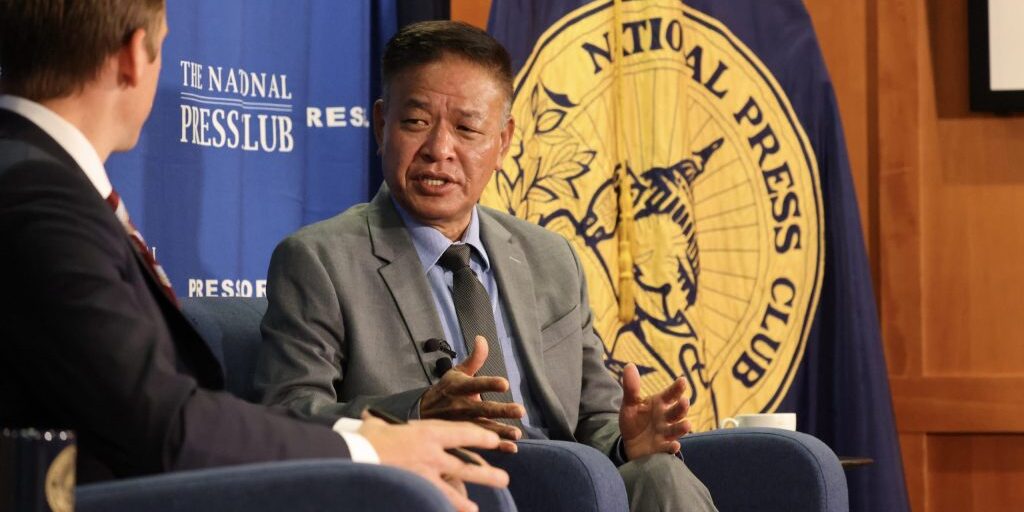


Sikyong Penpa Tsering, the democratically elected leader of the Central Tibetan Administration (CTA), concluded a series of high-level engagements in Washington, D.C., where he emphasized the urgent need for democratic nations to respond collectively to China’s expanding global influence and deepening repression in Tibet.
On October 28, the Tibetan leader began his day with an interview with James Himberger, Managing Editor of The National Interest, at the Office of Tibet. Later that day, he met with a group of distinguished researchers from a Washington-based think tank specializing in China. The discussions focused on Beijing’s increasing leverage in trade, economy, and rare earth elements, as well as its efforts to reshape global governance to suit its authoritarian model.
Joining the meeting were Representative Namgyal Choedup, Tsultrim Gyatso, the Chinese Liaison Officer at the Office of Tibet, and Tsejin from the International Campaign for Tibet, along with the think-tank experts. The dialogue underscored China’s use of economic dependency and coercive diplomacy to strengthen authoritarian regimes across Asia, Africa, and Latin America.
A Message of Nonviolence and Vigilance at the National Press Club
The following day, October 29, Sikyong addressed the National Press Club Headliner Newsmaker Event, where he engaged with journalists, policy experts, and members of the public on the situation in Tibet and the broader implications of China’s policies.
Speaking candidly, he described Tibet as “the biggest open-air prison in the world” where “press freedom does not exist and civil society is nonexistent.” He condemned Beijing’s intensified efforts to eradicate Tibetan cultural identity through colonial-style boarding schools and surveillance measures reminiscent of George Orwell’s 1984.
Since 2009, Sikyong noted, 157 Tibetans have self-immolated in protest against Chinese rule, a desperate plea for global attention that continues to go largely unanswered. He warned that under President Xi Jinping, Beijing’s campaign to “Sinicize” all nationalities is erasing linguistic, religious, and cultural distinctiveness across regions including Tibet, Xinjiang, and Inner Mongolia.
“China talks about a century of humiliation under Western powers but never about its own colonization of Tibet,” Sikyong said, highlighting the hypocrisy in Beijing’s narratives of victimhood.
Critique of Western Complicity and Economic Dependence
Sikyong’s remarks went beyond Tibet to address what he termed the “self-defeating complicity” of liberal democracies that have fueled China’s rise. He criticized Western nations for allowing authoritarianism to strengthen through trade imbalances and technological cooperation.
“Who made the dragon so strong to bite back at you? It’s the liberal democracies,” he said, citing the United States’ $300 billion trade deficit with China and the European Union’s $400 billion deficit as examples of how democratic nations have empowered Beijing’s global ambitions.
He detailed how China’s Belt and Road Initiative (BRI) has entrapped developing nations in cycles of debt and dependency, citing the Chinese takeover of strategic ports in Cambodia, Sri Lanka, Pakistan, and Greece. These, he warned, serve dual commercial and military purposes that threaten regional stability.
“Nothing comes for free from China,” he said. “They invest to control — whether through ports, mines, or digital surveillance.”
Tibet’s Enduring Faith in Nonviolence
Throughout his address, Sikyong reaffirmed the Middle Way Approach envisioned by His Holiness the Dalai Lama — a nonviolent and mutually beneficial path that seeks genuine autonomy for Tibet within the framework of China’s constitution.
He lamented, however, that there is currently “no space for meaningful negotiation” with Beijing, describing China’s leadership as devoid of “common sense.” Still, he stressed that the Tibetan movement endures on hope and moral strength.
“Without hope, our movement could have died long ago,” he said. “But we continue because our struggle is rooted in truth and nonviolence.”
U.S. Support and Global Advocacy
Sikyong also traced the long-standing relationship between the Tibetan administration and the United States, recalling key milestones from the Dalai Lama’s 1987 Five-Point Peace Plan to the recent Resolve Tibet Act, signed into law by President Joe Biden in July 2024.
He expressed gratitude for Washington’s bipartisan and bicameral support, while emphasizing that continued aid — such as funding for Voice of America and Radio Free Asia — remains critical for sustaining Tibetan resilience and countering China’s information blockade.
“These funds not only support the Tibetan movement but also preserve our culture and language — things systematically destroyed inside Tibet,” he said.
On the Dalai Lama’s Successor and Beijing’s Interference
Addressing global curiosity about the Dalai Lama’s succession, Sikyong reaffirmed that His Holiness has entrusted the Ganden Phodrang Trust with overseeing the process in consultation with senior Buddhist leaders and traditional oracles.
He condemned China’s Order No. 5 (2007), which asserts Beijing’s authority to approve reincarnations, calling it “a law by a government that does not even believe in religion.”
“If the Chinese government is really serious,” he quipped, “they should first look for Mao’s reincarnation.”
A Call to Global Leaders
In his closing remarks, Sikyong urged democratic nations to adopt a united and principled stance toward Beijing.
“China respects only strength, not weakness,” he warned. “If you keep feeding the dragon, you will one day find yourself being ridden by it.”
He cautioned that doing business with China without ethical safeguards only enables authoritarian expansion, urging governments to think beyond short-term profits.
“Democracies must stop strengthening authoritarianism,” he said. “The world’s silence today will only embolden repression tomorrow.”
Despite the government shutdown and unusually quiet streets around Capitol Hill, Sikyong’s Washington engagements reflected a determined push by the Tibetan administration to sustain visibility, deepen alliances, and keep Tibet on the global agenda — even as China’s economic and political influence grows.