


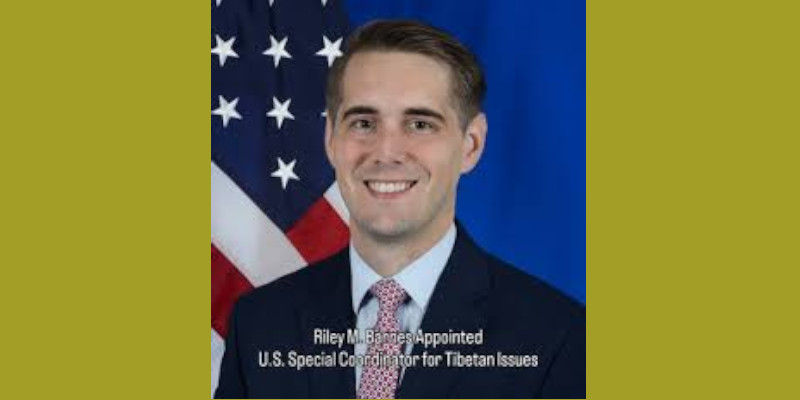


The United States has designated Riley M. Barnes, Assistant Secretary of State for Democracy, Human Rights, and Labor (DRL), to concurrently serve as the United States Special Coordinator for Tibetan Issues, according to a statement released by the United States Department of State.
Barnes will continue leading the Bureau of Democracy, Human Rights, and Labor while also assuming responsibility for coordinating U.S. government policy on Tibet. The position had remained vacant following the recent change in administration.
U.S. Reaffirms Commitment to Tibetan Rights
In its statement, the State Department reiterated Washington’s long-standing position on Tibet, affirming that:
“The United States is committed to advancing the human rights of Tibetans, including supporting efforts to preserve Tibetans’ distinct linguistic, cultural, and religious heritage, and their ability to freely choose and venerate religious leaders without interference.”
The Special Coordinator role was established under the Tibetan Policy Act of 2002. The statute mandates the office to coordinate U.S. policy on Tibet, promote dialogue between the Chinese government and the Dalai Lama or his representatives, and support efforts to safeguard Tibetan religious freedom, cultural identity, and fundamental human rights.
For Tibetans both inside Tibet and in exile, the continuation of this position is viewed as symbolically and diplomatically significant, particularly amid ongoing concerns over religious freedom, cultural assimilation policies, and restrictions on Tibetan language education.
Rank and Precedent
Although the Tibetan Policy Act has traditionally associated the position with the rank of under secretary, Barnes currently serves at the assistant secretary level. Most recently, Uzra Zeya held the role of Special Coordinator while serving as Under Secretary of State for Civilian Security, Democracy, and Human Rights during the Biden administration.
However, Barnes’ designation is not without precedent. During the Trump administration, Robert Destro, then Assistant Secretary of State for Democracy, Human Rights, and Labor, was appointed in 2020 to concurrently serve as Special Coordinator for Tibetan Issues after the position had remained vacant since 2017.
Observers note that while the rank may carry symbolic weight, the continuity of the office itself signals that Tibet remains on the agenda of U.S. human rights policy.
Barnes’ Background in Diplomacy and Human Rights
Before assuming his current role, Barnes held several senior positions within the State Department, including Senior Advisor to the Under Secretary for Political Affairs, Deputy Assistant Secretary in the Bureau of Democracy, Human Rights, and Labor, and Deputy Assistant Secretary for International Organization Affairs. He also served as Senior Advisor to the Ambassador-at-Large for International Religious Freedom, worked as a senior speechwriter for the Secretary of State, and was part of the Department’s policy planning staff.
Prior to joining the State Department, Barnes served as senior speechwriter to then–Senate Majority Whip John Cornyn of Texas, gaining experience in legislative affairs and strategic political communication.
A native of Uvalde, Texas, Barnes earned a Bachelor’s degree in politics from Washington and Lee University and holds a Master’s degree in international relations from the Bush School of Government and Public Service at Texas A&M University.
Significance for the Tibetan Community
The reactivation of the Special Coordinator role comes at a time of heightened international attention to religious freedom and the question of succession for Tibetan spiritual leadership. For Tibetans worldwide, including exile communities in India and the United States, the appointment is seen as a reaffirmation of Washington’s policy support for dialogue, religious freedom, and the preservation of Tibetan identity.
While the effectiveness of the office ultimately depends on sustained diplomatic engagement, Barnes’ concurrent designation signals continuity in U.S. policy engagement on Tibet under the new administration.