


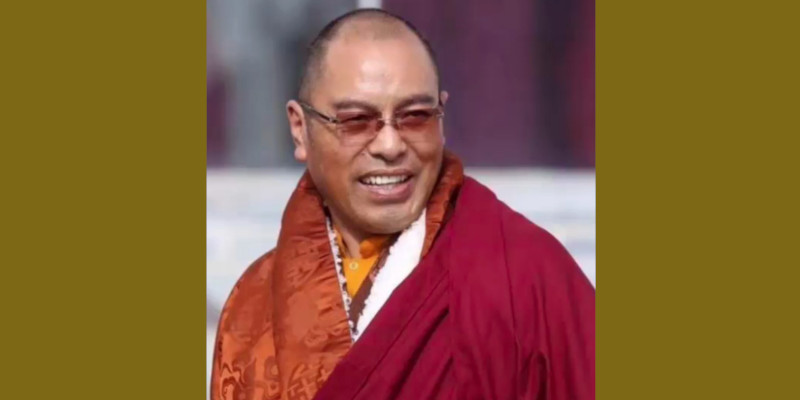


A group of United Nations human rights experts has issued a joint communication to the Vietnamese government demanding clarity, accountability, and justice over the detention, enforced disappearance, and death in custody of Tulku Hungkar Dorje, a revered Tibetan Buddhist leader who died in Vietnam after being detained in a joint operation involving Vietnamese and Chinese authorities.
The letter, registered as AL VNM 4/2025 and dated 8 August 2025, was sent by four UN mandates — the Working Group on Arbitrary Detention; the Working Group on Enforced or Involuntary Disappearances; the Special Rapporteur on Extrajudicial, Summary or Arbitrary Executions; and the Special Rapporteur on Minority Issues.
As Tibetan Journal previously reported, Chinese authorities began targeting him in 2024 for refusing to host the Beijing-appointed Panchen Lama, composing long-life prayers for His Holiness the Dalai Lama, and failing to implement state directives in his education projects. After multiple interrogations, he fled to Vietnam in September 2024, where he was later detained and died in custody under mysterious circumstances.
UN Experts’ Findings
According to the communication, Tulku Hungkar Dorje was arrested on 25 March 2025 in Ho Chi Minh City and held incommunicado for four days before authorities claimed he died of a “heart attack” on March 28 — despite no known history of heart disease. His body was reportedly cremated without family consent, without an autopsy or independent investigation, and under conditions of secrecy and tight surveillance.
The UN experts expressed deep concern over these actions, emphasizing that “states bear heightened responsibility for the safety and well-being of persons in custody.” They warned that the failure to conduct an impartial and transparent investigation “not only undermines the right to life as protected under Article 6 of the International Covenant on Civil and Political Rights (ICCPR)” but also violates obligations to prevent enforced disappearances and uphold due process.
Background of Persecution
Born in 1969 in Gade County, Golog, Tulku Hungkar Dorje was recognized as the 10th throne holder of Lung Ngon Thubten Choekor Ling Monastery and the reincarnation of Do Khyentse Yeshe Dorje. A respected scholar and humanitarian, he founded the Gesar Philanthropic Foundation in 2004 and established more than a dozen schools offering free education to Tibetan nomadic children, as well as medical and relief programs.
In 2024, Chinese authorities reportedly targeted him for refusing to host the Beijing-appointed Panchen Lama, composing long-life prayers for the Dalai Lama, and failing to implement government education policies in his schools. After multiple interrogations, he fled to Vietnam in September 2024, where he was later detained.
UN Demands to Vietnam
The joint communication urges Vietnam to:
-
Disclose the legal grounds for Tulku Hungkar Dorje’s arrest and any cooperation with Chinese intelligence.
-
Detail his detention conditions, transfers, and medical care prior to his death.
-
Confirm whether an autopsy was conducted and if results were shared with his family.
-
Provide records of investigations, prosecutions, and disciplinary measures.
-
Share disaggregated data on all deaths in custody in Vietnam since 2014.
Pending a credible response, the UN experts call on Vietnam to preserve all evidence, ensure independent monitoring, and prevent recurrence of such violations.
Tibetan and Global Reactions
The Central Tibetan Administration (CTA) and the Tibetan Centre for Human Rights and Democracy (TCHRD) have welcomed the UN intervention, calling it “a critical step toward international accountability.”
TCHRD stated that the communication “validates the long-standing Tibetan concerns about transnational repression and the complicity of states in China’s efforts to silence Tibetan voices abroad.”
Tibetan communities worldwide continue to hold vigils and protests demanding that Vietnam and China be held responsible. Demonstrations in New Delhi, Dharamshala, and London have drawn attention to what Tibetans describe as an “orchestrated extrajudicial killing of a revered lama under Beijing’s transnational repression campaign.”
A Broader Pattern
The death of Tulku Hungkar Dorje underscores the increasing cross-border reach of China’s persecution of Tibetan religious and cultural figures. His case joins a growing list of Tibetans targeted beyond Chinese borders, reflecting a broader erosion of human rights safeguards and international norms.
The UN communication marks the first formal acknowledgment by international mechanisms of the extraterritorial threats faced by Tibetan leaders, reinforcing the urgent call for global scrutiny and justice.