
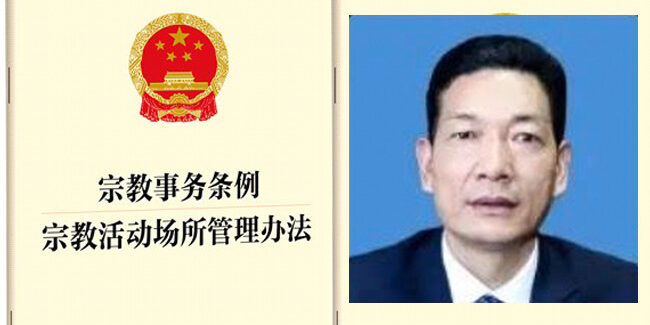
The Qinghai Provincial Disciplinary Inspection Commission announced that Tenzin, a senior Tibetan official and former deputy director of the Qinghai Provincial Forestry and Grassland Department, has been expelled from the Communist Party of China (CPC) and had his personal property confiscated. The Commission accused him of “losing faith,” “engaging in religious activities,” and “forgetting the Party’s original intentions.”
According to the report by Tibet Times, the disciplinary statement further alleged that Tenzin “used his authority for personal gain,” “accepted gifts,” and “failed to report personal matters,” — the kind of vague and politicized accusations often used by Chinese authorities to suppress Tibetan officials who quietly observe religious practices or express cultural loyalty.
Religious Restrictions on Tibetan Officials and Citizens
Beijing has long enforced a strict ban on religious practice among Communist Party members and government officials, particularly in Tibetan areas. Over the past decade, the Chinese government has issued multiple laws and directives to control and monitor religious activity, including the 2018 Religious Affairs Code and the 2022 Internet Religious Information Service Management Measures.
In practice, this means that Tibetan officials are forbidden from visiting monasteries, lighting incense, or engaging in even basic acts of devotion. At major religious sites such as the Potala Palace in Lhasa, electronic ID scans are used to block entry for government employees, retired officials, and university staff. When their IDs are scanned, alarms are triggered, preventing access.
The campaign has extended to retired officials as well. A 2019 notice by the Tibet Autonomous Regional Government required local departments to report whether retired Party members were visiting monasteries, effectively criminalizing private religious expression.
A Pattern of Political Purges
Tenzin’s case is not isolated. Over the past two years, at least 20 senior Tibetan officials have been dismissed under similar accusations of “loss of faith” and “violation of party character.”
Among them are Sherab Gyatso, former Deputy Secretary-General of the Communist Party of Tibet; Che Dgra Lha, head of the Tibetan Autonomous Regional Government; and even Wu Yingjie, the former Party Secretary of the so-called Tibet Autonomous Region, who was expelled in late 2023 on identical charges of “loss of faith.”
Such cases illustrate a systematic purge targeting Tibetan officials—particularly those suspected of holding religious beliefs or maintaining cultural ties to Tibetan Buddhism. These dismissals are carried out without transparent legal proceedings, leaving those accused with no means to appeal or defend themselves.
Erosion of Basic Rights
Human rights observers note that China’s policy towards Tibetan officials reflects a deep contradiction: while promoting “ethnic unity” and “religious freedom” in official discourse, Beijing punishes Tibetans for acts as simple as visiting a monastery or expressing spiritual devotion.
These campaigns not only violate the right to belief, enshrined in international human rights law, but also expose the hypocrisy of the Communist Party’s claim to “rule of law.” In occupied Tibet, religion remains one of the most tightly policed aspects of life, and Tibetans—whether monks, students, or government officials—continue to be persecuted simply for holding onto their faith and cultural identity.
As Beijing expands its ideological control, Tenzin’s arrest stands as another chilling reminder that Tibetans remain foreigners in their own land—punished for their beliefs, silenced for their conscience, and stripped of the rights every human being deserves.
Source: This article is based on a Tibetan-language report from TibetTimes.net. English translation and contextual analysis by Tibetan Journal.




Leave a Reply