
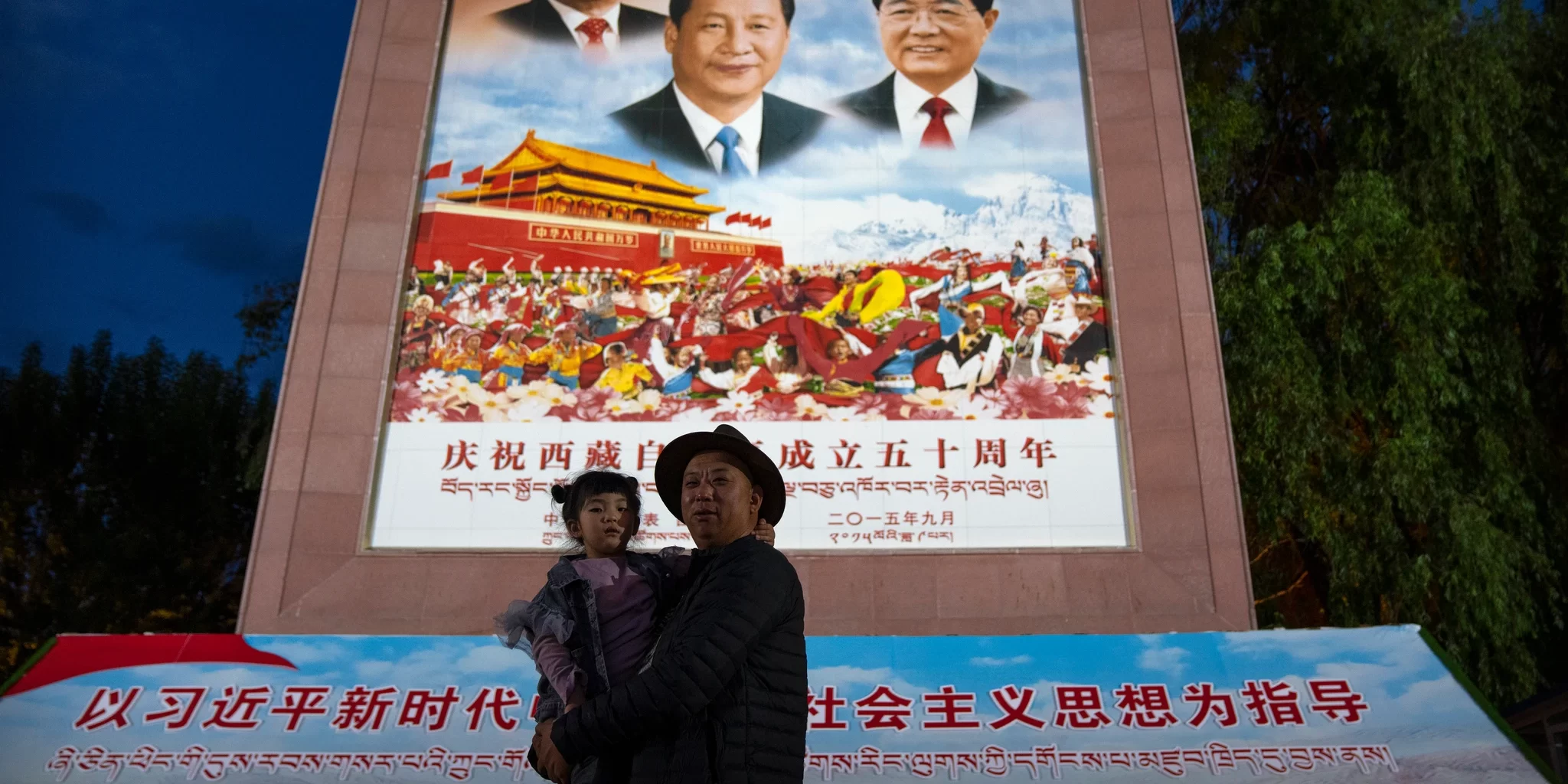
Chinese authorities are continuing to station more than 22,000 Communist Party and government officials across thousands of villages in the Tibet Autonomous Region, as part of a long-running rural governance program that Tibetan advocates say combines political indoctrination, surveillance and assimilation with development initiatives.
The International Campaign for Tibet said the latest annual rotation, known as the 15th batch of village-stationed cadres, was formally welcomed at a high-level meeting held in Lhasa on May 18.
During the meeting, Tibet Autonomous Region Communist Party Secretary Wang Junzheng praised previous village work teams and instructed the newly deployed officials to strengthen political education, grassroots Party organisations, rural development and social stability.
According to official descriptions of the program, approximately 5,600 work teams comprising more than 22,000 officials are assigned to villages throughout the region. The cadres generally live and work in the communities for one-year rotations, resulting in an average presence of about four officials in each village.
The village deployment program began in 2011 and has since become a permanent feature of Chinese governance in Tibet. ICT estimates that more than 297,000 individual cadre deployments have taken place over 15 rotations.
Chinese authorities describe the initiative as a means of improving rural governance, raising household incomes, strengthening border communities and connecting residents with public services.
However, ICT said the scale and political responsibilities of the work teams make the program one of the most intensive systems of state presence at the village level anywhere under Chinese Communist Party rule.
Cadres instructed to enter Tibetan homes
At the May meeting, Wang reportedly instructed the officials to continue programs in which Party cadres enter villages and households to “form pairs and make friends” with local residents.
Under the initiative, individual cadres are assigned to Tibetan households, which they visit regularly and, in some instances, stay with overnight. Officials present these visits as a way to build relations between the Party and local communities.
ICT said the arrangement also enables authorities to collect information about families, monitor their political views and identify conduct considered a potential threat to social stability.
During household visits, cadres are tasked with explaining government policies, promoting Xi Jinping’s political ideology and encouraging what Chinese authorities call a strong sense of community for the Chinese nation.
The officials also promote Mandarin Chinese and Chinese national celebrations in Tibetan communities, according to ICT.
The campaign has been implemented alongside other extensive grassroots initiatives, including household surveys and political education programs. Wang called for a “100-day large-scale survey of villages and households” as part of the latest deployment.
ICT described the pairing program as a system in which government officials effectively become state-assigned relatives who can monitor private households while guiding residents toward Party-approved political and cultural practices.
Political control and rural development
The village-stationed cadre program was initially expanded during China’s nationwide poverty-alleviation campaign. Following Beijing’s declaration that extreme poverty had been eliminated, its focus increasingly shifted toward political education, national identity, border security and the strengthening of grassroots Party organisations.
The regional government has identified five principal areas of work for the village teams: promoting Chinese national identity, opposing separatism, defending border areas, increasing rural incomes and maintaining social stability.
ICT said development assistance under the program cannot be separated from its political and security functions.
Human Rights Watch previously documented similar concerns, noting that village teams in Tibet were assigned political responsibilities that included maintaining stability, expanding Party organisations and conducting campaigns intended to foster gratitude toward the Communist Party.
Authorities have invested heavily in the program. According to figures cited by ICT from the Tibet Autonomous Region government, more than 20 billion yuan—approximately $2.8 billion—was spent between 2011 and 2024 on strengthening the Party’s presence across 5,594 villages.
Role in hydropower-related relocations
Village work teams have also played a role in implementing major state development projects and relocating affected communities.
ICT cited the example of Menling, known as Milin in Chinese, where village officials distributed hundreds of copies of bilingual legal material following the announcement of the Medog hydropower project in July 2025.
A cadre team leader stationed in Yusong village reportedly oversaw the relocation of 63 households, comprising 223 residents, to newly constructed homes within seven days.
The official claimed that work teams contacted around 10,000 people, secured agreements from 605 households and completed relocation work involving 2,587 residents across nine resettlement villages.
China has presented such relocation programs as part of economic modernisation and improvements in housing and public infrastructure. Rights organisations, however, have repeatedly raised concerns about whether affected Tibetans can freely object to relocation decisions or refuse projects promoted by Party authorities.
Greater concentration inside the Tibet Autonomous Region
Although similar work teams operate in Tibetan regions incorporated into Qinghai, Sichuan, Gansu and Yunnan provinces, their deployment is significantly less concentrated than in the Tibet Autonomous Region.
Qinghai reportedly dispatched 5,221 village work-team members in 2021, many of them to Tibetan areas. ICT estimates that several hundred officials may also be deployed in individual counties within Kardze, Ngaba and other Tibetan prefectures.
The much heavier deployment within the Tibet Autonomous Region reflects Beijing’s treatment of the area as a major political and security priority, ICT said.
The officials stationed in border villages near India, Nepal and Bhutan are assigned additional responsibilities involving border settlements, infrastructure development and local defence mechanisms.
Many of these communities have been developed under China’s “xiaokang,” or moderately prosperous village, program. Beijing says the initiative improves living standards in remote border regions, while analysts and Tibetan advocacy groups view the settlements as part of a broader strategy to reinforce territorial claims and increase state control along the Himalayan frontier.
Program expected to continue
Wang urged the latest group of cadres to make their work “deeper and more solid,” signalling that the village deployment system is unlikely to be reduced.
The program offers Chinese authorities a direct channel to monitor conditions at the local level and ensure the implementation of central policies in even the most remote Tibetan communities. Officials who perform well during their village assignments may also receive career and promotion advantages.
ICT warned that under President Xi Jinping, the initiative has developed into a central element of Chinese policy in Tibet, combining economic programs with ideological, assimilationist and security objectives.
The organisation expects further policy directions to emerge from the anticipated 11th Tibet Autonomous Region Party Congress and the next Central Tibet Work Forum.
The previous Central Tibet Work Forum was held in August 2020 and established policy priorities that included political stability, border security, the Sinicisation of Tibetan Buddhism and the strengthening of a shared Chinese national identity.
With the 15th deployment now underway, tens of thousands of officials will remain embedded in Tibetan villages, extending the direct presence of the Chinese Party-state into the daily and private lives of rural Tibetan families.






Leave a Reply