
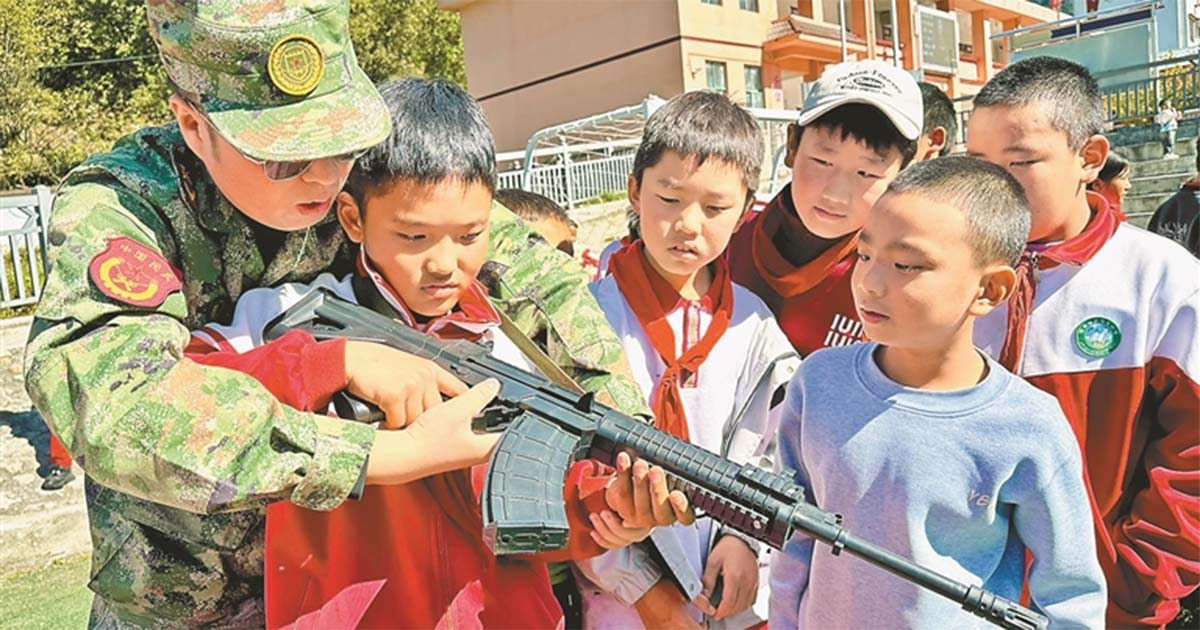
New evidence from inside Tibet reveals an alarming escalation in the Chinese Communist Party’s (CCP) systematic effort to reshape the identity of Tibetan children through ideological indoctrination, militarized education, and enforced loyalty to the Party. Newly surfaced reports from Chinese state media — often presented as routine “patriotic education” — show elementary school children being exposed to military weapons training, Maoist propaganda, and “red heritage” campaigns beginning as early as age seven.
Military Training in Elementary Schools
In Medog County in southern Tibet, state media showcased a scene that has disturbed Tibetan observers worldwide: an army veteran demonstrating a QBZ-191 rapid-fire rifle — a standard weapon of the PLA — to elementary school students. The rifle, designed for battlefield use, is far removed from any reasonable curriculum for young children.
Beijing frames these activities as part of “defense education in schools,” claiming they instill patriotism and protect the “security and prosperity of border regions.” However, analysts warn that the true purpose is to secure early political loyalty among Tibetan youth and prepare them for future military service under the Chinese state. The militarization of Tibetan schools is now a well-documented component of the Party’s broader assimilationist agenda.
Mao Worship and Forced Immersion in ‘Red Culture’
Militarization is only one arm of the CCP’s campaign. Another is the deepening ideological indoctrination of Tibetan children through institutionalized Maoist propaganda.
A recent report from Lhasa described a school excursion of fourth-grade students to the Mao Badge Museum. The activity was explicitly organized under the slogan:
“Passing on the red heritage and strengthening the sense of community of the Chinese nation.”
The visit was advertised as an “immersive learning experience,” where children were told to “internalize red culture” — a phrase commonly used in Party rhetoric to indicate ideological submission. The museum and school have reportedly established partnerships to “promote patriotic education” on an ongoing basis.
This forced infusion of Maoist ideology into Tibetan childhood stands in stark contrast to the cultural and religious values that families in Tibet have historically passed down across generations.
‘Passing on the Red Gene’: An Engineered Identity Overhaul
The CCP’s repeated use of phrases such as “passing on the red gene” reflects its goal: replacing Tibetan cultural identity with a Party-centered, militarized nationalism. These programs are closely tied to the broader system of state-run boarding schools, where over one million Tibetan children have been separated from their families, language, and religion.
Observers say these practices represent the largest state-sponsored cultural reengineering project in Tibet since the Cultural Revolution.
A Concerning Trajectory for Tibet’s Future
For Tibetan communities in exile, the latest revelations are deeply troubling. They confirm that despite China’s claims of “modernization” and “development,” the state is advancing policies that deliberately dismantle indigenous cultural foundations and replace them with loyalty to the CCP.
Unlike normal education systems, the goal here is not academic learning — it is political transformation.
Conclusion: Why This Matters
This intensified indoctrination of Tibetan children highlights the Chinese government’s long-term strategy to reshape Tibetan identity from the ground up. It also underscores a disturbing truth: Beijing is investing more resources into ideological control of Tibetan children than into preserving their language, culture, or community wellbeing.
This development exemplifies how Chinese propaganda and coercive state power continue to shape daily life in Tibet — often in ways the outside world rarely sees. And while institutions in some countries respond sensitively to Tibetan concerns, others remain reluctant to confront Beijing’s growing influence, enabling these policies to continue unchecked.


Leave a Reply