
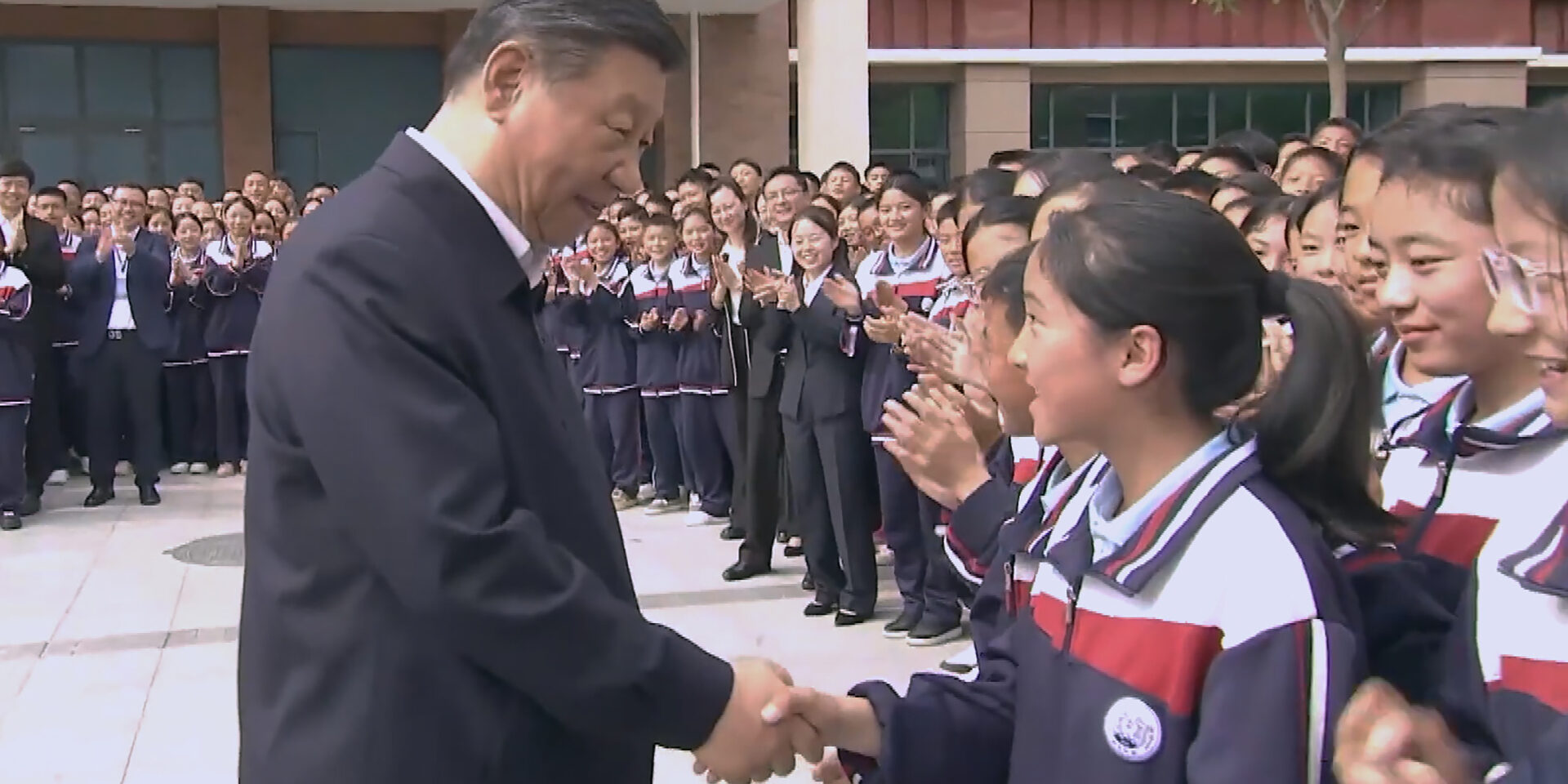
In a move widely seen as an attempt to counter mounting international criticism, the Chinese government recently convened an “International Conference on Residential School Education and Highland Development” in Chengdu, Sichuan Province, to defend its controversial boarding school policy that has forcibly separated nearly one million Tibetan children from their families.
According to Chinese state media, the conference—held on October 27, 2025, at the University of Electronic Science and Technology of China—brought together domestic and foreign participants, including experts from the United States, the United Kingdom, and Canada. Chinese officials claimed that the policy of residential schooling “promotes educational equality, interethnic exchange, and national integration,” and even hailed Tibet’s boarding schools as “a model of education that respects local culture.”
However, Tibetan and international rights groups have long denounced these assertions as a blatant cover-up of what they call a systematic campaign to eradicate the Tibetan language, religion, and way of life. The policy—enforced since the 1980s but dramatically expanded under Xi Jinping—places children as young as four in state-run boarding schools where instruction is conducted exclusively in Chinese, with little or no access to Tibetan cultural or religious education.
The Chinese Institute for Tibetan Studies’ deputy director, who spoke at the Chengdu meeting, praised residential schools for adapting to Tibet’s “unique natural and geographical conditions” and improving “educational quality.” Such rhetoric, however, stands in stark contrast to reports by human rights experts warning that the policy is part of a broader strategy of cultural assimilation.
International Response and Human Rights Concerns
Global institutions have repeatedly condemned China’s residential school system in Tibet. In December 2023, the European Parliament in Strasbourg passed a resolution calling for the immediate suspension of Beijing’s policy, which it described as an “unprecedented scale of cultural destruction.” The resolution underscored that over one million Tibetan children have been removed from their families and placed in Chinese-language institutions, cutting them off from their native language, religion, and heritage.
Similarly, the U.S. Congressional-Executive Commission on China, in its report submitted to the UN Human Rights Council in November 2020, documented widespread separation of Tibetan children from their families under the guise of educational reform. The report stated that these institutions “strip Tibetan children of their linguistic and cultural identity,” violating multiple international human rights conventions, including those protecting minority rights and cultural freedom.
UN human rights experts have also expressed grave concern, noting that the residential school policy “undermines family integrity and cultural continuity,” and that such practices may constitute a form of forced assimilation prohibited under international law.
A Systematic Erasure of Tibetan Identity
While Beijing claims that by 2025, 85 percent of the population will be fluent in Chinese—a figure presented as evidence of “national progress”—Tibetans and observers see it as an alarming indicator of cultural extinction. With plans suggesting that by 2035, China’s rural and minority languages will be further absorbed into Mandarin dominance, the trajectory points toward the deliberate erasure of Tibet’s linguistic heritage.
From “tent schools” and “horseback schools” introduced in the 1950s to the sprawling residential campuses of today, the evolution of education in Tibet reflects a shift from access-based reform to control-based assimilation. Parents and children now struggle even to communicate with one another, as generations grow up speaking different languages.
Despite international outrage, Beijing continues to frame its education policy as an “equitable development model,” seeking legitimacy through conferences like the recent Chengdu gathering. Yet for Tibetans, this model represents not progress, but the deliberate dismantling of a civilization rooted in language, faith, and community.
Conclusion
China’s bid to defend its residential school policy through international conferences only deepens global skepticism about its true intentions. The ongoing effort to replace Tibetan language and identity with state-imposed nationalism underscores a grave human rights crisis unfolding under the banner of “educational equality.” The world’s democratic institutions must not allow Beijing’s propaganda to overshadow the lived reality of Tibetan families—separated, silenced, and stripped of their cultural lifeblood.


Leave a Reply