
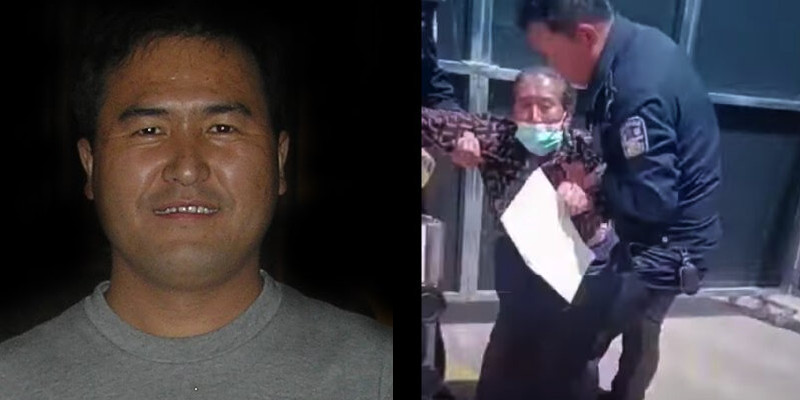
The Tibetan Centre for Human Rights and Democracy (TCHRD) has issued a grave warning regarding the deteriorating condition of imprisoned Tibetan businessman Dorje Tashi, who is currently serving a life sentence at Drapchi Prison in Lhasa. According to new information obtained by his lawyer and family members, Dorje Tashi has endured repeated assaults, escalating restrictions, and systematic denial of legal and family access—raising serious concerns about violations of both Chinese domestic law and international human rights standards.
Brutal Assault Inside Drapchi Prison Revealed During Restricted Lawyer Visit
During a heavily monitored, non-contact meeting on 29 October 2025, lawyer Wang Fei learned that Dorje Tashi was violently beaten by three inmates in early April 2025, leaving him with significant injuries on his forehead. The meeting occurred behind a “prison mirror” and under full audio surveillance—conditions that themselves violate international standards for confidential legal access.
This assault is not an isolated case. In April 2021, eight inmates reportedly attacked him without explanation. After Wang Fei’s last successful meeting in 2020, authorities repeatedly blocked all attempts at further access, deepening concerns about his treatment and safety.
Under the UN Standard Minimum Rules for the Treatment of Prisoners (Mandela Rules), prisoners must be protected from torture, violence, and intimidation by both staff and other inmates. TCHRD notes that the prison’s failure to prevent repeated assaults amounts to a clear violation of these obligations.
Family Denied Visitation Amid Arbitrary Delays and Intimidation
On 29 April 2025, Dorje Tashi’s brother Dorje Tseten publicly described a month-long struggle to secure a family visit, recounting arbitrary postponements and intimidation by prison officials despite earlier assurances.
“I stayed for four days solely for a visit, but they kept delaying and wasting time,”
he said, adding that officials claimed Dorje Tashi was under “disciplinary punishment.”
Tseten called on the TAR and Lhasa Municipal People’s Procuratorates to intervene, stressing that authorities are knowingly ignoring their legal responsibility to guarantee visitation rights and prevent maltreatment.
Sister Gonpo Kyi Targeted for Peaceful Advocacy, Suffers Serious Injuries
Dorje Tashi’s sister Gonpo Kyi, known for her persistent peaceful appeals for her brother’s fair treatment, has been routinely harassed, detained, and placed under extreme psychological and physical pressure.
On 18 August 2025, as she attempted to leave the family-run Yak Hotel to request a visit for her brother, security officers forcibly detained her, restricting her movement and isolating her from her family. Two days later, under intense pressure, she attempted suicide by jumping from the hotel’s second floor, sustaining serious leg and back injuries.
Her peaceful protests have included a sit-in outside the TAR Higher People’s Court on 20 February 2024, during which she held a portrait of Xi Jinping—an act underscoring both her desperation and her attempt to appeal directly to the highest political authority.
A Prominent Entrepreneur Punished for Refusing Corruption
Once recognised as one of the most successful Tibetan entrepreneurs in Lhasa—known for his charitable projects and contributions to the community—Dorje Tashi was sentenced to life imprisonment in 2010 on alleged “loan fraud” charges. Tibetan sources and rights groups widely regard the charges as politically motivated, noting that he had refused demands for luxury favors from local officials.
In August 2021, Dorje Tashi staged a 15-day hunger strike to protest his wrongful imprisonment and treatment. Instead of addressing his concerns, authorities reportedly forced him to undergo IV treatment to end the strike.
Violations Under China’s Own Prison Law and International Standards
China’s Prison Law requires authorities to:
-
Protect prisoners’ physical safety
-
Provide timely medical care
-
Ensure lawful visitation rights
-
Prevent torture, abuse, and maltreatment
Article 14 further mandates oversight by People’s Procuratorates to prevent abuses. Yet the continued assaults, blocked legal visits, arbitrary punishments, and retaliation against family members reveal a systematic failure to enforce even China’s own legal requirements.
TCHRD warns that the pattern of abuse also contravenes international human rights law—including rights to family contact, legal representation, bodily integrity, and protection from arbitrary detention.





Leave a Reply