

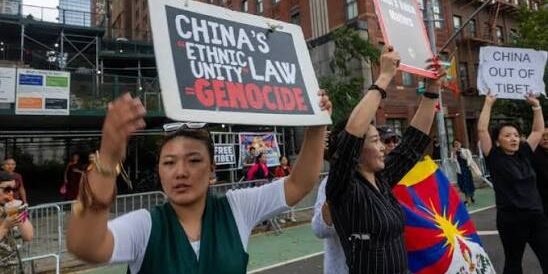
Around 30 Tibetan activists were detained by Indian police on Aug 19 while staging a protest outside Hyderabad House in New Delhi, where Chinese Foreign Minister Wang Yi met India’s National Security Advisor Ajit Doval for the 24th round of Special Representatives’ talks on the boundary question.
Led by the Tibetan Youth Congress, protesters shouted slogans such as “Free Tibet” and “End repression” while waving Tibetan national flags. They accused Beijing of committing “cultural genocide” in Tibet and interfering in the Dalai Lama’s reincarnation. Police cited security concerns during the high-level talks, detaining the demonstrators to maintain order before releasing them later the same day, reported The Logical Indian.
India-China Talks: Progress Amid Protests
Wang Yi’s visit included meetings with External Affairs Minister S. Jaishankar on Aug 18, Prime Minister Narendra Modi on Aug 19, and Ajit Doval on Aug 19–20. According to reports in The Financial Express and India Today, the two sides reached agreements to:
-
Reopen border trade at Lipulekh, Shipki La, and Nathu La passes
-
Resume direct flights between the two countries
-
Expand the Kailash Manasarovar pilgrimage routes
-
Establish new mechanisms for managing border tensions
Chinese state media Xinhua reported that the meeting produced a 10-point consensus, with the next round of boundary talks scheduled to take place in China in 2026.
Modi’s Firm Message on Borders
Prime Minister Modi reiterated to Wang that peace and stability along the India-China border remain a prerequisite for any meaningful progress in bilateral relations. He emphasized that without tranquility at the borders, broader ties cannot develop “healthily or sustainably.”
Despite tensions, Modi noted that India-China ties have made “positive and steady” progress since his meeting with President Xi Jinping in Kazan last year. He accepted Xi’s invitation to attend the upcoming Shanghai Cooperation Organization (SCO) summit in Tianjin later this month.
Tibetans’ Call for Freedom Amid Diplomatic Thaw
While Indian and Chinese leaders hailed their discussions as constructive, Tibetan protesters highlighted ongoing repression inside Tibet. Their demand for freedom and resistance against Beijing’s policies offered a sharp counterpoint to the upbeat tone of the official meetings.
As India and China move toward stabilizing relations, the Tibetan question remains a stark reminder of the unresolved human rights crisis under Chinese rule. For Tibetans in exile, Wang’s visit was not just another diplomatic engagement but yet another moment to raise their voices for freedom.


Leave a Reply