
At a landmark hearing of the U.S. Congressional-Executive Commission on China (CECC), American lawmakers issued some of the strongest public calls in decades for a decisive shift in U.S. policy on Tibet. The hearing, titled “China’s War on Religion: The Threat to Religious Freedom and Why It Matters to the United States,” examined Beijing’s repression of Tibetan Buddhism, Uyghur Islam, Chinese Christianity, and other faith communities. Tibet emerged as a central focus, with witnesses and legislators warning that China’s refusal to negotiate has reached a breaking point.

Brownback Calls for a 60-Day Deadline on China
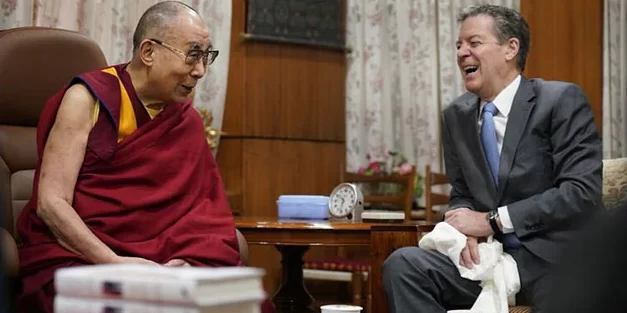
Former U.S. Ambassador-at-Large for International Religious Freedom Sam Brownback described the situation in Tibet as “cultural genocide” and urged lawmakers to move beyond symbolic statements. He emphasized the need for clear consequences if Beijing continues to block dialogue with Tibetan leaders.
Brownback argued that the United States should categorically reject China’s claim to control the reincarnation of His Holiness the Dalai Lama and send senior officials — including Vice President J.D. Vance or Secretary of State Marco Rubio — to Dharamsala to meet the Tibetan spiritual leader directly.
He then issued the most striking proposal of the hearing:
If China refuses to agree to the Dalai Lama’s Middle Way Approach within 60 days, the United States should announce its recognition of an independent Tibet .
McGovern Supports Ultimatum: ‘We Need Consequences’
CECC Co-Chair Rep. Jim McGovern, one of the strongest bipartisan voices on Tibet, publicly supported Brownback’s call for a deadline. He said Congress must consider options that go beyond condemnations.
McGovern stated that if China continues to reject dialogue and suppress Tibetan autonomy,
Congress should formally recognize Tibet as an independent country .
He emphasized that Tibet cannot be left in a state of permanent occupation while China erodes Tibetan religion, culture, and identity. McGovern also pressed for the U.S. administration to fully use the tools provided by Congress — including sanctions, diplomatic pressure, and enforcement of the 2020 Tibetan Policy and Support Act (TPSA).
Bhuchung Tsering: International Pressure Is Essential
Bhuchung K. Tsering, representing the International Campaign for Tibet, testified as the Tibetan witness on the panel. He underscored that Tibetans have consistently pursued a peaceful solution through the Dalai Lama’s Middle Way Approach, but Beijing’s refusal to negotiate has stalled progress for more than a decade.
Tsering stated that international pressure — including measures like those proposed by Brownback and McGovern — is essential to bring China back to the table .
He also detailed China’s tightening control over Tibetan Buddhism, its manipulation of reincarnation processes, and its expanding campaign of transnational repression targeting Tibetan diaspora communities. Tsering highlighted the disappearance of Chinese student Zhang Yadi, a follower of Tibetan Buddhism who was detained in China after peaceful advocacy in France.
Hearing Highlights: China’s Religious Repression at Home and Abroad
The hearing documented how Beijing systematically undermines religious freedom across all major communities:
-
Tibetan Buddhists: heavy restrictions on monasteries, state interference in reincarnation, and ideological control over monks and nuns.
-
Uyghur Muslims: mass detention and criminalization of religious practice.
-
Chinese Christians: harassment, surveillance, and imprisonment of clergy.
-
Other groups: including Chinese meditation and faith communities facing cross-border intimidation.
Witnesses described how Beijing exports repression beyond its borders through surveillance, harassment, and pressure on foreign governments to silence Tibetan and Chinese dissident communities. Lawmakers warned that China’s actions pose a global challenge to religious freedom and democratic norms.
Reaffirming Core U.S. Tibet Policy Priorities
Tsering reiterated seven core U.S. policy expectations under the Tibetan Policy and Support Act of 2020 and the 2002 Tibet Policy Act, including:
-
Sanctions on Chinese officials who interfere in reincarnation
-
Release of Tibetan political prisoners, including the Panchen Lama
-
Action against China’s transnational repression
-
Public disclosure of Chinese officials denied access to the U.S. under the Reciprocal Access to Tibet Act
-
Ensuring access to Tibet for diplomats, journalists, and civil society
-
Stronger multilateral cooperation at the UN and with democratic allies
-
A renewed push for unconditional dialogue between Tibetan and Chinese leaders
He urged the U.S. government to press Beijing—both privately and publicly—to return to meaningful negotiations without preconditions.
A Rising Tide of Congressional Pressure on Beijing
While Brownback’s 60-day ultimatum is not official U.S. government policy, the hearing marked a significant escalation in congressional sentiment. Influential lawmakers now openly acknowledge that decades of Chinese repression have invalidated assumptions that Tibet’s political status is settled.
China’s refusal to negotiate, combined with its control over religion and identity, is driving renewed debate in Washington over how far the United States should go in defending Tibetan rights.
For Tibetans, this growing pressure in the U.S. Congress represents a crucial development:
a clear signal that Beijing’s actions are no longer viewed as tolerable, and that stronger international responses may be on the horizon.





Leave a Reply