
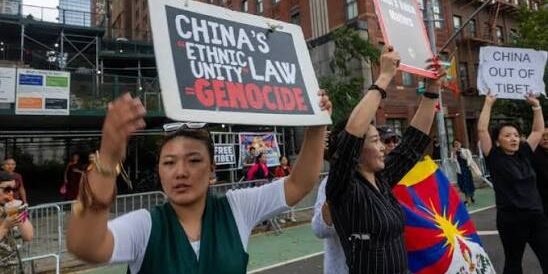
Belgian lawmakers have raised concerns that China’s new Law on Promoting Ethnic Unity and Progress could intensify the erosion of Tibetan identity inside Tibet while also exposing Tibetans and other diaspora communities abroad to new forms of pressure and transnational repression.
The issue was raised during the final meeting of the Belgian Federal Parliament’s Foreign Affairs Committee before the summer recess on July 15, where members questioned Deputy Prime Minister and Foreign Minister Maxime Prévot about the implications of the law, which entered into force on July 1.
For Tibetans, the debate is significant because it represents growing recognition in Europe that China’s policies toward Tibet cannot be viewed solely as a domestic human rights issue. Lawmakers warned that the new legislation could affect not only the cultural, linguistic and religious rights of Tibetans inside Tibet but also activists, scholars, journalists and community members living beyond China’s borders.
Belgian Lawmakers Question Impact on Tibetans
Foreign Affairs Committee Chair Els Van Hoof, together with MPs Katrijn van Riet, Britt Huybrechts and Annick Lambrecht, questioned the Belgian government about the law’s implications for Tibetans, Uyghurs, Southern Mongolians and other groups.
The parliamentarians expressed concern that the legislation could further institutionalize policies aimed at weakening distinct ethnic, linguistic and religious identities in favor of a state-defined common Chinese national identity.
For Tibetans, such concerns are particularly significant amid continuing restrictions on Tibetan-language education, religious institutions, expressions of loyalty to His Holiness the Dalai Lama and other forms of cultural and political expression.
The lawmakers also focused on what they described as the law’s potential extraterritorial reach.
They warned that provisions in the legislation could create risks not only for people living under Chinese jurisdiction but also for activists, academics, NGOs, elected representatives and members of diaspora communities overseas who speak publicly about Tibet, Xinjiang, Southern Mongolia and other politically sensitive issues.
The MPs asked whether Belgium had fully assessed these implications, whether it was coordinating with the European Union, and whether the government intended to raise concerns directly with Beijing and in international forums, including the United Nations Human Rights Council.
They also sought assurances that Belgium would be prepared to protect individuals on its territory from intimidation, surveillance or other forms of transnational repression.
Belgium Says Extraterritorial Reach Requires Attention
Responding to the committee, Foreign Minister Maxime Prévot acknowledged that the law’s potential reach beyond China warranted particular scrutiny.
He said Belgium’s Foreign Ministry and its diplomatic mission in China were closely examining the legislation, including the risks it may pose to freedom of expression, academic freedom and other fundamental rights outside China.
Prévot also confirmed that Belgium continues to raise human rights concerns involving different communities in China through bilateral diplomatic contacts, within the European Union and in multilateral forums.
On transnational repression, the minister said reports of intimidation or interference involving individuals in Belgium are taken seriously and stressed that protecting those living on Belgian territory falls within the responsibilities of the country’s security and intelligence services.
For Tibetan communities in Europe, such recognition is important because concerns over Chinese pressure abroad have grown alongside reports of surveillance, intimidation and efforts to influence institutions and public discourse related to Tibet.
Why the New Law Matters for Tibet
China’s Law on Promoting Ethnic Unity and Progress came into force on July 1, 2026.
Chinese authorities describe the legislation as a measure intended to strengthen national unity, promote ethnic solidarity and reinforce a shared national identity.
Human rights organizations and critics, however, have warned that the law could further institutionalize assimilationist policies affecting Tibetans, Uyghurs, Southern Mongolians and other communities.
For Tibetans, the concern lies not only in the language of the law itself but in the wider political environment in which it is being implemented.
Inside Tibet, Chinese authorities have steadily expanded policies promoting Mandarin-language education, political control over Tibetan Buddhist institutions, restrictions on Tibetan cultural expression and increasingly centralized oversight of religious and educational life.
The new legislation has therefore been viewed by Tibetan advocates as part of a broader effort to weaken the foundations through which Tibetan identity is transmitted across generations.
Concerns have intensified because some provisions of the law are also understood to extend beyond China’s territorial borders, raising questions about whether Beijing may seek to apply political pressure against those who criticize its ethnic policies from abroad.
From Repression Inside Tibet to Pressure Abroad
For decades, international concern over Tibet has largely focused on restrictions imposed inside Tibet itself.
The debate in Belgium suggests that governments are beginning to confront another dimension of the issue: whether China’s policies may increasingly affect Tibetans who live, study, organize and advocate outside Chinese territory.
This concern is especially relevant for the Tibetan diaspora.
For Tibetans who fled or were born in exile, countries in Europe, North America and South Asia have provided spaces where they can preserve their language and culture, operate independent media, organize political movements and publicly advocate for Tibet without the direct restrictions imposed inside Tibet.
But those spaces are not necessarily immune from Chinese influence.
Reports of transnational repression have raised concerns that Tibetan activists and organizations abroad may be subject to monitoring, pressure, threats against relatives inside Tibet or attempts to shape institutions and public discussions in host countries.
The Belgian parliamentarians’ focus on the extraterritorial implications of the new law therefore marks an important development.
It signals that scrutiny of China’s policies toward Tibet is beginning to extend beyond questions of what happens inside Tibet to whether Beijing’s political reach can also affect the freedoms of Tibetans living elsewhere.
Lawmakers Call for Coordinated European Response
In their concluding remarks, members of the Foreign Affairs Committee urged Belgium and the European Union to respond with clarity and determination.
They warned against allowing economic interests to overshadow human rights concerns and called for sustained international attention to the situation of Tibetans, Uyghurs, Southern Mongolians and other communities affected by China’s ethnic policies.
For Tibetans, the significance of the Belgian debate lies precisely in this widening international focus.
The concern is no longer only whether Tibetan language, religion and identity can survive under increasingly restrictive policies inside Tibet.
It is also whether Tibetans abroad can continue to speak, organize, research and advocate freely without facing pressure from the same state they sought freedom from in exile.
Belgium’s parliamentary scrutiny suggests that this broader dimension of China’s Tibet policy is beginning to receive greater political attention in Europe.




Leave a Reply