
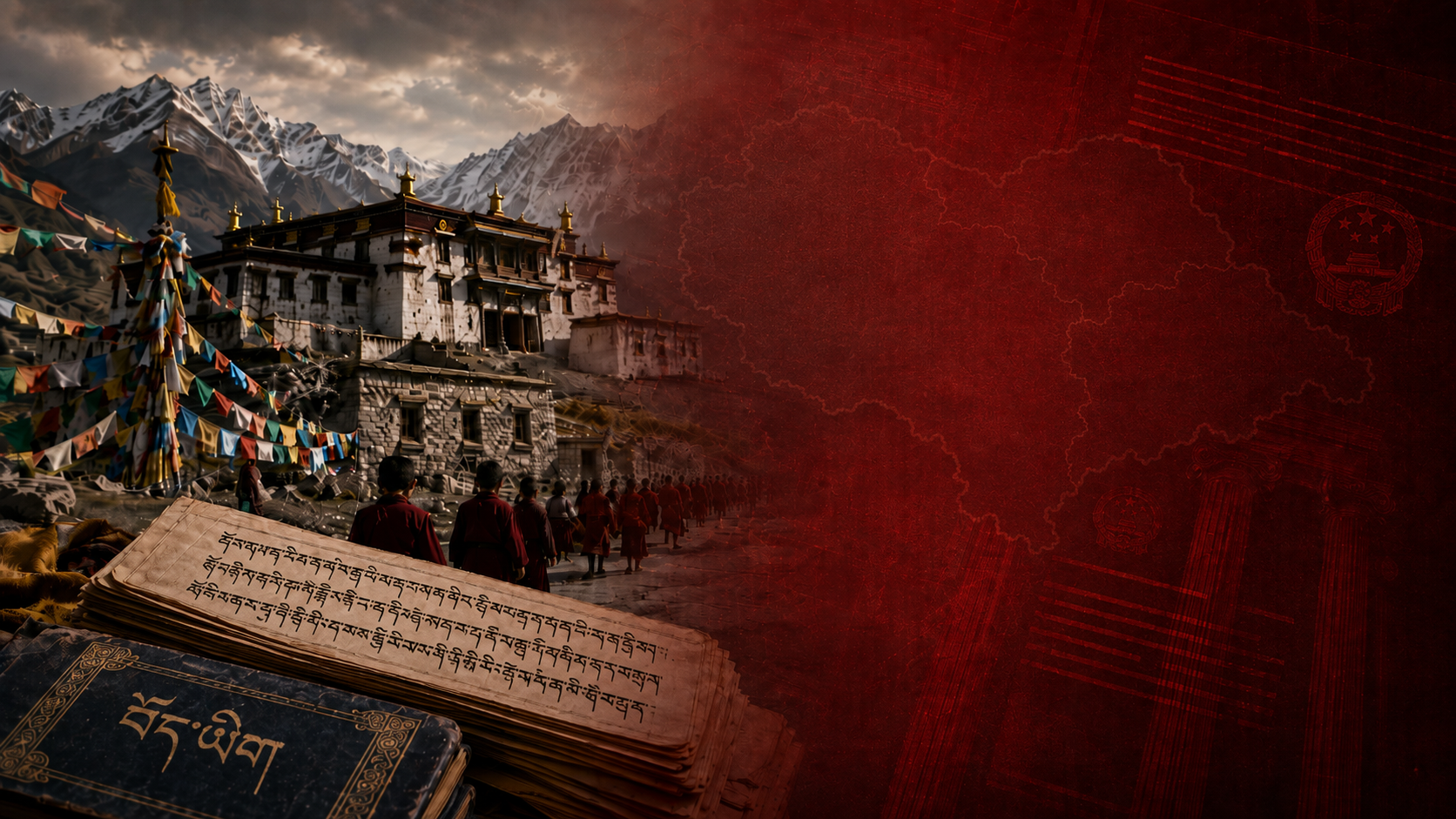
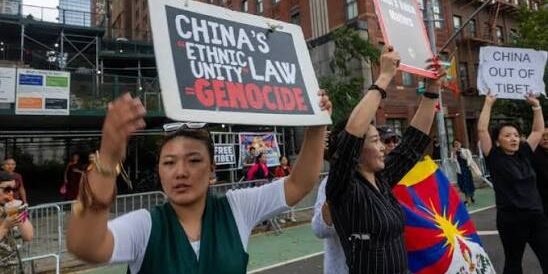
In early March 2026, the CCP adopted a new law on oppressed minorities that emphasizes strengthening its rule over them with more ruthless measures. The law was implemented on 1 July 2026.
This new law was drafted under the framework of the “Ethnic Policy in the New Era” of Xi Jinping’s thought, which developed following the 2014 Central Ethnic Work Conference, as Xi imposed increasingly harsh policies on ethnic groups to assimilate them into a more Chinese identity under his concept of “Forging a Strong Sense of the Chinese National Community,” in the name of socialist modernization and greater unity.
Carl Minzner, a senior fellow for China studies at the Council on Foreign Relations (CFR), argued that the new law’s core concept is captured in the term zhulao (铸牢)—to “forge” or “cast” metal—and its instruction that “forging the communal consciousness of the Chinese nation” is core to the Party’s ethnic policies.[1]
This new law is thus the culmination of a policy trajectory rooted in Xi’s ideology and Sinicization strategy toward minorities. In the author’s view, this represents a further enforcement of the CCP’s assimilationist policies toward ethnic groups.
The essence of life cannot be obtained through excessive material values alone, but also through the human spirit, which yearns for freedoms and rights. When such freedoms and rights are undermined and deprived by the CCP regime, it raises the question of how prosperity can be defined without core human values.
Such a systematic policy became more active after it was formally incorporated into the CCP’s Party Charter during the 19th National Congress of the Chinese Communist Party in 2017, and it has since played a key role in enforcing this policy throughout systems of ethnic governance.
The latest law, called the Ethnic Unity and Progress Law, was formally promulgated on 12 March 2026 during the 14th National People’s Congress (NPC). It contains seven chapters and 65 articles.
The essence of the new law can be seen in two important provisions.
According to Article 1:
“This Law is drafted on the basis of the Constitution in order to promote ethnic unity and progress, forge a strong sense of the community of the Chinese people, advance the establishment of the community of the Chinese people, and promote the realization of the great rejuvenation of the Chinese people.”[2]
In this context, the law explicitly states that it is designed to forge a strong sense of community among the Chinese people in order to establish a more unified Chinese society and promote what it describes as the “great rejuvenation of the Chinese people.”
The term “Chinese society,” however, is often understood within a Han-centric framework, while “rejuvenation” is closely connected with socialist modernization under Xi’s ideology and Sinicization policy. In practice, this risks forcibly absorbing minorities into a more Han-Chinese cultural framework rather than protecting, preserving, and cherishing their distinct values, despite protections formally written into the Constitution.
Such constitutional guarantees often remain little more than paper protections when ethnic peoples are unable to exercise them freely and are instead pressured to embrace Han-Chinese norms and unquestioningly obey CCP directives.
Thus, the CCP’s China cannot simply be understood as operating through the rule of law, but rather through the rule of the Party and its authoritarian political system.
This cannot genuinely be described as ethnic unity and progress when it conflicts with the spirit of the 1984 Regional Ethnic Autonomy Law. Rather, the author views it as a systematic effort to dilute minority ethnic identities and weaken the foundations that sustain them.
Language and Education Under the New Law
Article 15, paragraph two, of the new law states:
“Schools and other educational institutions are to use the nation’s common language and script as the basic language and script for education and teaching. The state is to promote preschool students’ learning of Mandarin, so that youth who have completed compulsory education have a basic understanding of the nation’s common language and script.”[3]
In this regard, the CCP has clearly prioritized Mandarin over other ethnic languages.
Although many minority ethnic groups have their own languages, the state has designated Mandarin as the common national language and has increasingly promoted it through education and public institutions.
According to Ashley Carnahan, citing China’s Seventh National Population Census:
“China’s population stands at 1.44 billion as of November 2020, according to the Seventh National Population Census released in 2021 by the National Bureau of Statistics. Of that total, 91.11% were Han Chinese and 8.89% belonged to ethnic minority groups.”[4]
Nevertheless, a national language policy should not simply be based on the numerical dominance of one population group, but should respect the linguistic integrity of all peoples within a state.
The CCP has increasingly sought to weaken minority languages through restrictive measures and mandatory Mandarin-language policies in the name of ethnic unity, progress, and modernization, despite formal protections for ethnic minority languages.
Such policies have been implemented particularly through schools, where language education plays a central role in transmitting culture and identity from one generation to another.
In this sense, the new law risks becoming a strategic tool for weakening the continued existence of distinct ethnic identities.
James Leibold, a professor at Australia’s La Trobe University, described the law as putting a “death nail in the Party’s original promise of meaningful autonomy.”[5]
Language is an indispensable lifeline for any people, and schools are among the most important institutions through which language, history, culture, and identity are transmitted.
This is why the CCP has increasingly targeted these fields through patriotic education policies intended to make young people more loyal, devoted, and submissive to the Party.
Implications for Tibet
When it comes to the Tibetan people, this law represents another major wave in the CCP’s effort to separate Tibetans from their culture, language, history, traditions, and religion, ultimately weakening Tibetan identity.
The adoption of the law cannot be understood only through how it is described on paper. Rather, it must also be examined in the context of the broader Sinicization policies being implemented across Tibet.
According to the International Campaign for Tibet:
“An analysis of the evolution of this new ethnic policy as outlined by the law shows that Chinese authorities used the Tibetan community to test and fine-tune this coercive assimilationist policy for more than a decade before formalizing it at the national level through this new law. The law reflects the culmination of Xi Jinping’s focus on consolidating power in the party and eliminating threats, as well as the ideas of a new generation of ethnic policy thinkers who advocate the dilution of ethnic identity. It prescribes the coercive assimilation of Tibetans and therefore further undermines Tibetans’ fundamental freedom to preserve their unique culture, religion and way of life.”[6]
This illustrates how the CCP has increasingly enforced policies on ethnic groups, including Tibetans, that dilute their distinct cultural values.
Tibet has remained one of the CCP’s core political interests because of its unique geopolitical location, rich natural resources, distinguished culture, long historical development, profound Buddhist tradition, linguistic heritage, ethical values, and traditional customs.
These are among the reasons why the CCP invaded Tibet in 1950 under what it called “peaceful liberation” and has since maintained strict control over Tibet while pursuing policies intended to Sinicize Tibetan society.
Tibetans, however, continue to regard Tibet and China as historically distinct nations.
The Tibetan Centre for Human Rights and Democracy has stated:
“The law constitutes a direct assault on the survival of Tibet’s distinct cultural heritage and represents a serious violation of Tibetans’ rights to maintain their identity, practice their culture, and exercise meaningful autonomy.”[7]
Since 1950, the CCP has employed both soft and hard forms of power over the Tibetan people.
These policies are often presented as benefiting Tibetans through poverty alleviation, modernization, infrastructure development, and rural revitalization. At the same time, however, Tibet has experienced extensive political repression and policies that Tibetans and human rights organizations have criticized as threatening the survival of Tibetan culture, language, religion, and identity.
In particular, the CCP has increasingly sought to weaken the Tibetan language, reshape Tibetan Buddhism, and dilute Tibetan cultural traditions through coercive policies.
These remain among the core foundations of Tibetan identity that Tibetans have preserved and promoted for generations.
According to Tsering Dolma:
“In Tibetan society, religion, language, and culture are not separate domains but form a deeply integrated whole. Any state intervention targeting a single element, particularly language or cultural expression, inevitably extends to the religious sphere as well.”[8]
The CCP has also attempted to legitimize its policies toward Tibetans through laws and regulations that formalize state control.
In the CCP’s framework, peace and development are often defined through acceptance of Party rule and political loyalty.
Yet freedoms and rights are fundamental aspirations of human beings regardless of social, cultural, or ethnic differences.
Tibetans have continued to seek these freedoms despite decades of political repression and restrictive policies.
Although the CCP has established control over Tibet’s physical territory, it has not succeeded in winning the hearts of Tibetans merely through material development. Tibetan aspirations to preserve their language, religion, culture, identity, and fundamental rights have not disappeared.
These aspirations are unlikely to disappear unless the policies that threaten them are fundamentally changed.
If the current oppressive policies continue in Tibet, the CCP may face growing tensions and instability, both internally and internationally.
History repeatedly demonstrates that political power cannot permanently extinguish the aspirations of a people. Truth can ultimately prevail over falsehood, and peaceful resistance can survive even in the face of overwhelming force.
For more than seven decades, the CCP has repeatedly miscalculated the depth of Tibetan attachment to their identity and homeland.
The new Ethnic Unity and Progress Law, therefore, should not simply be viewed as an administrative measure promoting ethnic unity. In the author’s view, it represents a systematic instrument of neo-colonialism and a further reinforcement of the CCP’s Sinicization policy toward Tibetans and other ethnic minorities.
References
1. Carl Minzner, “China’s New Ethnic Unity Law: From Autonomy to Assimilation,” Council on Foreign Relations, 26 March 2026. Accessed 2 May 2026.
2. Ethnic Unity and Progress Law, translated from Chinese by China Law Translate, 12 March 2026. Accessed 1 May 2026.
3. Ethnic Unity and Progress Law, China Law Translate, Article 15, 12 March 2026. Accessed 1 May 2026.
4. Ashley Carnahan, “China Passes ‘Ethnic Unity’ Law in Push for Assimilation,” Fox News, 12 March 2026. Accessed 2 May 2026.
5. Politico, 11 March 2026. Accessed 2 May 2026.
6. International Campaign for Tibet, analysis of China’s new Ethnic Unity and Progress Law, 13 March 2026. Accessed 2 May 2026.
7. Tibetan Centre for Human Rights and Democracy, analysis of the Ethnic Unity and Progress Law, 24 March 2026. Accessed 3 May 2026.
8. Tsering Dolma, “The New Law on Ethnic Unity: A Threat to Tibetan Buddhism,” Bitter Winter, 30 March 2026. Accessed 3 May 2026.
Disclosure: This article is published as a guest opinion. The views, arguments, and interpretations expressed are solely those of the author and do not necessarily reflect the editorial position of Tibetan Journal.



Leave a Reply