
The cancellation of a major international Tibetan studies conference in Nepal, alongside reports that Beijing has sought restrictions on Tibetan exile media ahead of the BRICS Summit in India, is renewing concerns over China’s growing efforts to influence how Tibet is studied, discussed and reported beyond its borders.
The Nepal government has cancelled the 17th Seminar of the International Association for Tibetan Studies (IATS), which was scheduled to take place in Kathmandu later this month after nearly four years of preparation.
The gathering, organized with Kathmandu University and the Rangjung Yeshe Institute, was expected to bring hundreds of scholars from around the world to Nepal for one of the largest international academic forums dedicated to Tibetan studies.
Organizers confirmed that senior Nepalese government officials instructed Kathmandu University not to proceed with hosting the conference. The government has not publicly provided a detailed reason for the cancellation.
The decision, however, followed sustained concerns from Chinese officials over the gathering.
Reports in Nepal said Chinese Ambassador Zhang Maoming had raised objections with Nepalese authorities over the conference, amid concerns in Beijing that discussions involving Tibet, His Holiness the Dalai Lama and other politically sensitive subjects could emerge during the event.
The Associated Press reported this week that the conference was cancelled at the request of Nepalese government officials, while noting Nepal’s close relationship with China and its longstanding restrictions on Tibetan political activity.
The development has raised concerns not simply over the cancellation of an academic conference, but over the growing reach of Chinese pressure on Tibet-related expression outside Tibet.
Academic Freedom Under Pressure in Nepal
The IATS seminar is an international scholarly gathering rather than a political conference. Researchers working on Tibetan history, language, religion, philosophy, anthropology and other fields have participated in its seminars for decades.
The cancellation therefore raises questions over whether geopolitical pressure is increasingly narrowing the space available even for independent academic study of Tibet in neighboring countries.
The controversy had already emerged before the cancellation.
Chinese officials reportedly expressed concern about the participation of Tibetans in exile and discussions considered politically sensitive by Beijing. Meanwhile, Chinese state-affiliated academic institutions were preparing a substantial presence at the conference, including a large delegation associated with the China Tibetology Research Center.
As pressure mounted, Tibetan scholars in exile reportedly faced growing uncertainty surrounding their participation.
The eventual cancellation brought an abrupt end to years of preparation by the organizers and has generated concern among scholars about political interference in academic freedom.
It also fits within a longer and well-documented pattern in Nepal.
Nepal is home to a longstanding Tibetan refugee community and historically served as one of the most important transit routes for Tibetans escaping across the Himalayas into exile. But as Nepal’s political and economic relationship with Beijing has deepened, Tibetan refugees have faced increasing restrictions on political demonstrations and other activities considered sensitive to China.
Human Rights Watch documented this problem more than a decade ago, reporting that Chinese pressure had contributed to restrictions on Tibetan political expression, surveillance, arbitrary detention and limitations on cultural and religious activities in Nepal.
The latest cancellation suggests that the concern may no longer be limited to demonstrations by Tibetan refugees. It now reaches an international academic gathering devoted to studying Tibet itself.
Tibetan Voices Under Pressure to India
Similar concerns are now emerging in India, home to the world’s largest Tibetan exile community and the headquarters of the Central Tibetan Administration.
As Chinese President Xi Jinping is expected to travel to New Delhi for the BRICS Summit scheduled for September 12 and 13, Beijing has reportedly raised concerns with Indian authorities over media accreditation for Tibetan exile and Falun Gong-affiliated news organizations.
According to a report by ThePrint, Chinese Embassy officials have communicated concerns to Indian authorities as the Ministry of External Affairs processes accreditation for journalists attending the summit. Beijing is reportedly seeking to prevent Tibetan exile media from gaining access to spaces where journalists could question the Chinese delegation.
There is currently no indication that India has accepted the reported request, and decisions regarding media accreditation remain with the Indian government.
For Tibetans in India, however, concerns surrounding major visits by Chinese leaders extend considerably beyond media access.
Previous high-level Chinese visits have been accompanied by heightened police monitoring and restrictions on Tibetan demonstrations and activism. Ahead of Xi Jinping’s visit to Chennai and Mamallapuram in October 2019, Indian police detained Tibetan activists attempting to demonstrate near locations associated with the Chinese president’s visit, including his hotel and Chennai airport. Other Tibetan activists were reportedly taken into custody before planned protests could take place.
Similar restrictions have accompanied other politically sensitive Chinese visits and summits in India, where authorities have sought to prevent Tibetan demonstrations from approaching visiting Chinese leaders and diplomatic delegations.
These measures are implemented by Indian authorities, often on security and public-order grounds, rather than directly by Chinese officials. But they have long raised a difficult question for the Tibetan exile community: to what extent should the political sensitivities of visiting Chinese leaders determine Tibetans’ ability to exercise freedoms of expression and peaceful assembly in a democratic country?
The latest reported request regarding Tibetan journalists adds another dimension to that concern.
Tibetan exile media based primarily in Dharamshala play a particularly important role because independent reporting from inside Tibet remains severely restricted. Tibetan journalists outside China document political imprisonment, religious restrictions, language policies, environmental protests and other developments that are often inaccessible to international reporters.
If Beijing is now seeking to influence which of those journalists can enter accredited media spaces during a major international summit in India, the issue extends beyond who receives a press pass. It concerns whether the Chinese government can exert influence over which Tibetan voices are able to question its officials even after those voices have moved beyond China’s jurisdiction.
This distinction is particularly important for Tibetans.
Inside Tibet, peaceful political expression can result in detention and imprisonment. Displaying the Tibetan national flag, distributing political leaflets, possessing politically sensitive material or publicly expressing support for the Dalai Lama have all resulted in punitive action by Chinese authorities.
Outside Tibet, exile has historically provided Tibetans with freedoms unavailable in their homeland: the ability to organize political movements, operate independent media, protest Chinese policies, preserve religious institutions and publicly advocate for Tibet’s political future.
Yet major Chinese diplomatic visits have repeatedly demonstrated that those freedoms are not always exercised without restriction.
The reported effort surrounding the BRICS Summit therefore should not be viewed simply as a dispute over media accreditation. In the context of previous restrictions on Tibetan demonstrations during Chinese leaders’ visits, it raises a broader concern about whether Beijing’s political sensitivities are increasingly influencing the space available for Tibetan activism, journalism and political expression beyond China’s borders.
Repression Beyond Tibet’s Borders
Inside Tibet, independent journalism, political expression and public criticism of Chinese policies remain subject to extensive restrictions. Access to the region for foreign journalists and independent observers is also tightly controlled.
For Tibetans in exile, countries such as India and Nepal have therefore historically provided critical spaces in which Tibetan political, religious, cultural and intellectual life could continue outside direct Chinese state control.
But those spaces have increasingly come under pressure.
The phenomenon is part of what governments and human rights organizations describe as transnational repression—efforts by governments to intimidate, monitor, silence or otherwise constrain critics and diaspora communities beyond their national borders.
Tibetan communities have repeatedly been identified among the targets of such practices by Chinese authorities.
Reports have documented surveillance of Tibetans abroad, cyberattacks against Tibetan organizations, pressure on relatives remaining inside Tibet, monitoring of activists and attempts to discourage political activities in exile.
The United States State Department has previously identified Tibetans living abroad, particularly large refugee communities in India and Nepal, as targets of Chinese transnational repression.
A 2025 study by India’s Centre for Social and Economic Progress also examined Chinese influence operations among Tibetan diaspora communities in India and Nepal, describing expanded Chinese state capacity and increasingly sophisticated efforts to influence diaspora communities and political environments in South Asia.
The developments surrounding Kathmandu and New Delhi therefore do not exist in isolation.
They form part of a broader concern about whether Beijing is increasingly capable of influencing not only Tibetans living under its direct jurisdiction, but also the institutions and spaces through which Tibet is discussed abroad.
From Controlling Tibet to Controlling the Conversation About Tibet
The distinction is significant.
Inside Tibet, Chinese authorities exercise direct political control over schools, monasteries, media institutions and public expression. Outside Tibet, Beijing does not possess the same legal authority.
Influence therefore takes different forms: diplomatic pressure, economic leverage, pressure on host governments, surveillance of diaspora communities and attempts to shape access to political, academic and media institutions.
The cancellation of the IATS seminar demonstrates how consequential such influence can become.
A scholarly gathering involving researchers from around the world was preparing to discuss Tibet in Nepal. After Chinese objections and growing diplomatic pressure, the conference will no longer proceed there as planned.
In India, the reported effort to restrict Tibetan journalists from accredited media spaces at the BRICS Summit raises a related concern. Tibetan exile media exist in part because independent reporting on Tibet is extraordinarily difficult from within Tibet itself. Preventing those journalists from questioning Chinese representatives abroad would further narrow the already limited spaces in which Tibetan concerns can be put directly before Chinese officials.
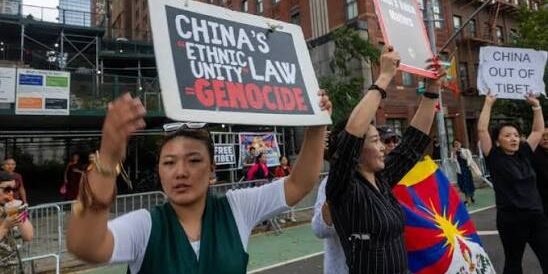
These developments also come amid heightened international scrutiny of China’s new Law on Promoting Ethnic Unity and Progress, which came into force on July 1.
The law strengthens Beijing’s emphasis on a common Chinese national identity and has drawn criticism from human rights organizations concerned about its implications for Tibetan language, religion and cultural identity.
Its potential reach beyond China has also attracted political attention in Europe.
During a July 15 meeting of the Belgian Federal Parliament’s Foreign Affairs Committee, lawmakers questioned Foreign Minister Maxime Prévot about provisions they feared could have extraterritorial implications for activists, academics, civil society organizations and diaspora communities.
Prévot acknowledged that the law’s extraterritorial dimension warranted particular attention and said Belgian authorities were examining its possible implications for fundamental rights beyond China’s borders.
A Shrinking Space for Tibetans Inside and Outside Tibet
For Tibetans, the developments present a troubling contradiction.
Those living inside Tibet face extensive restrictions on political expression, independent journalism, religious practice and public expressions of loyalty to the Dalai Lama.
Exile was supposed to provide the space in which those freedoms could survive.
India became the center of Tibetan political and cultural life in exile following the Dalai Lama’s flight from Tibet in 1959. Nepal became home to another significant Tibetan refugee population and served for decades as an essential bridge between Tibet and the outside world.
The concern today is whether China’s growing political and economic influence is gradually narrowing those spaces as well.
The cancellation of an international Tibetan studies conference in Kathmandu does not carry the same consequences as imprisonment or political repression inside Tibet. Nor is a reported diplomatic request concerning media accreditation equivalent to censorship unless the host government acts upon it.
But both developments point toward a broader challenge.
If Tibetans cannot freely discuss their political future inside Tibet, if scholars encounter political pressure when studying Tibet in Nepal, and if Tibetan journalists face attempts to restrict their access to Chinese officials in India, the question of Tibetan freedom increasingly extends beyond China’s territorial boundaries.
It becomes a question of whether the countries in which Tibetans live—and the institutions in which Tibet is studied and discussed—are prepared to protect their own academic freedom, press freedom and freedom of expression from external political pressure.
For a people whose voices are already heavily restricted inside their homeland, the ability to speak freely outside it is not a peripheral concern.
It may be one of the few spaces left in which Tibetans can still ensure that the world hears them.


Leave a Reply