
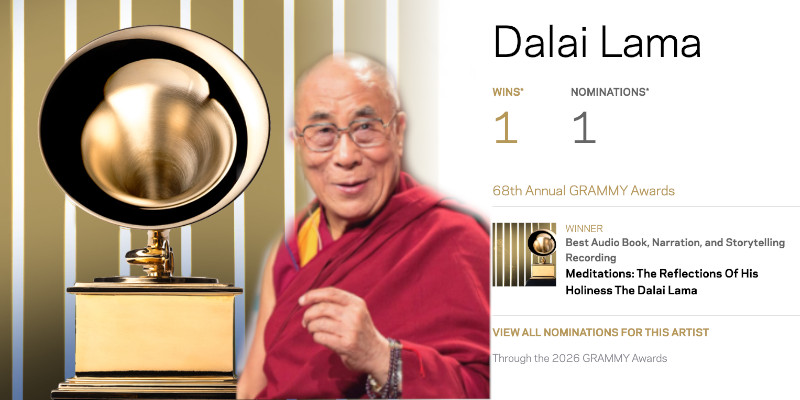
Beijing has lashed out at His Holiness the Dalai Lama’s first-ever Grammy Award, condemning the recognition as “anti-China political manipulation,” despite the absence of any dispute surrounding the award itself.
The Tibetan Buddhist spiritual leader received the Grammy on Sunday in the audiobook, narration, and storytelling category for Meditations: The Reflections of His Holiness the Dalai Lama. The honor was accepted on his behalf by musician Rufus Wainwright, who contributed to the recording.
Responding to the award, His Holiness the Dalai Lama said he accepted it “with gratitude and humility,” emphasizing that it was not a personal achievement but a reflection of shared human values.
“I don’t see it as something personal, but as a recognition of our shared universal responsibility,” he said, adding that peace, compassion, care for the environment, and an understanding of the oneness of humanity are essential for the well-being of all people.
China’s Foreign Ministry spokesperson Lin Jian dismissed the award, reiterating Beijing’s long-standing position toward the Tibetan leader. He claimed that the Dalai Lama is “not merely a religious figure but a political exile engaged in anti-China separatist activities,” and warned against using cultural platforms for political purposes.
The backlash, however, came solely from Beijing. There has been no objection or controversy from the Grammy Awards, the Recording Academy, or the international arts community regarding the decision.
His Holiness the Dalai Lama has lived in exile in India since 1959, after Chinese troops crushed a popular uprising in Lhasa, following an imminent threat to his life. Since then, he has remained the most visible global representative of Tibetans, advocating nonviolence and genuine autonomy for Tibet. Beijing, which claims Tibet as an “autonomous region” under its rule, continues to reject his position and labels him a separatist.
China has long been accused of undermining Tibetan language, culture, religion, and identity through policies of assimilation and political control. Any international recognition of the Dalai Lama routinely draws sharp criticism from Chinese authorities.
The Grammy episode also comes amid renewed tensions over the question of succession. Tibetan Buddhist tradition holds that the Dalai Lama is reincarnated through a spiritual process beyond political authority. The Dalai Lama has stated that his successor will be born in the free world and that China has no role in the process. Beijing insists that any future Dalai Lama must be approved by the Chinese state.
For Tibetans, China’s reaction to the Grammy reflects a familiar pattern: moral and cultural recognition of the Dalai Lama’s message of peace and shared humanity is met with political hostility. While Beijing seeks to frame the award as manipulation, many see it instead as a quiet but powerful affirmation of values that continue to resonate far beyond Tibet.



Leave a Reply